Scenario 02 · Street harassment
Followed after “No”
Notice the pressure. Find your options. Choose a safer next step.
16+ · Fictional scenario · 5–8 minutes + discussion
Watch · then practise
Alex’s story
A 54-second realistic visual sequence with Alex, Chris, a bystander and shop staff. Dialogue appears on screen; there is no audio. You may skip the video and begin the choices below.
Video transcript
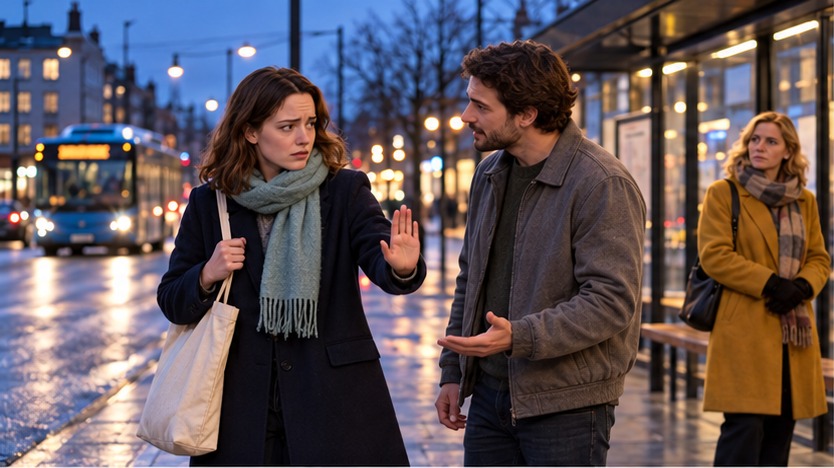
Alex: “No, I’m not interested. Please leave me alone.” Chris: “Come on, just talk to me.” Alex moves away; Chris follows. Alex notices their feet on the ground and spots the open staffed shop. Alex enters without further explanation: “Someone is following me. Can I stay here and contact someone?” A bystander asks: “Would you like me to stay?” Alex: “Yes, while I call my friend.” This is one fictional example. Explore other responses in the activity.
You can leave. You do not owe a conversation.
Alex is near shops and a station. After Alex clearly refuses unwanted attention, Chris continues talking and follows for a short distance. You will practise as Alex, then consider how a bystander could help.
This story includes harassment and being followed. There is no graphic content or time limit. You may pause, skip to reflection or stop at any time. No role-play or personal disclosure is required.
Optional camera mode overlays the fictional scene on your live camera view. It does not track markers or physical locations. Camera images are not recorded or uploaded. Keep your device still in a safe training space; do not walk while using it.
Local support settings · optional
Facilitators: enter verified local options before the session. These details stay in this page until it is closed or reloaded.
FICTIONAL TRAINING SCENE
Reflect · no score, no blame
Leaving is a valid choice.
You do not need to stay, argue or repeat a refusal to deserve safety. Freezing or struggling to speak is not a failure. Responsibility for harassment belongs to the person doing it.
- Which coping tool helped you notice your options?
- What was the safest available exit, and why?
- Which D was realistic: Delegate, Distract or Delay? When would Direct add risk?
- What support contact would you choose afterwards?
Your practice choices
Facilitator notes and optional role-play
Roles: target, follower, bystander and optional shop staff. Use adult actors. Agree boundaries and a stop signal before starting. No touching, improvised insults, blocking exits or actual following. Participants may observe instead.
Run: introduce the content and local support options; allow individual choices; discuss alternatives without ranking participants. The shop outcome is a fictional example, not a guarantee that staff will intervene.
Practise: noticing feet on the ground or an object nearby; spotting a staffed exit; optional brief boundary language; asking a specific person for a specific form of help. Grounding is optional and must not delay getting away.
Debrief: use the four questions above. Avoid asking anyone to describe personal experiences. In immediate danger, prioritise distance and appropriate local emergency help. Verify local numbers and staff routes before the session.
Camera use: open this HTML from an HTTPS website in a compatible browser. Allow camera access when asked. If embedded, the website must allow camera permissions; opening as a separate page is often easier. The screen version works without a camera or internet. Camera overlay is not marker-tracked or spatial AR.